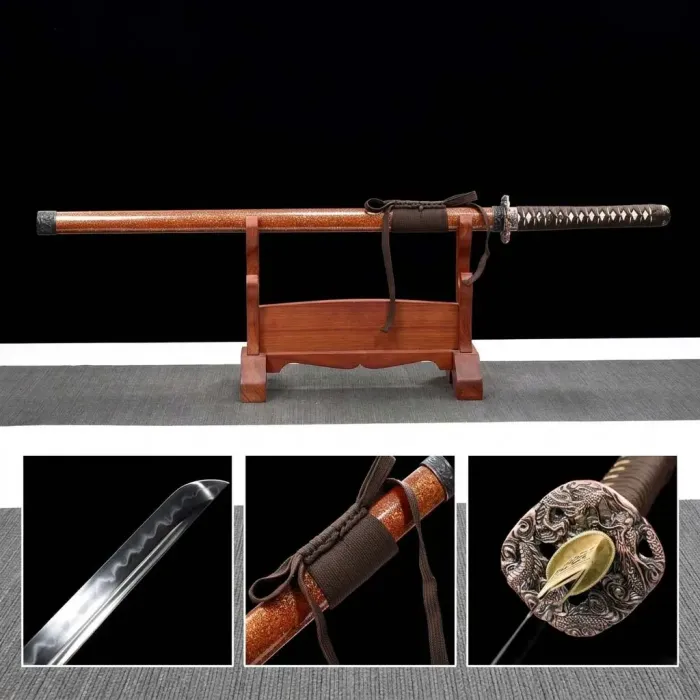
That customary historical sword serves as a impressive example of fabrication, but how about you strive for to express your own style? Adjusting your gear is a rewarding journey, allowing you to build a truly exceptional piece. From the haft wrapping and collar to the shield design and hamon, each component offers a chance for unique expression. This analysis delves into the field of katana adjustments, providing knowledge for both rookies and skilled enthusiasts aiming to form their impression on the age-old art of the samurai.
Introductory Genuine Handiwork
For learners determined to embark on the rewarding journey of eastern weapon training , 1060 steel katanas present an superb entry point. This distinct grade of basic steel obtains a sweet spot between cost and capability . While not reaching hard as supreme steels, 1060 allows for a manageable level of blade refinement , making it fitting for apprentices to enhance the groundwork of blade care and enjoy the grace of genuine Japanese weaponry. It’s a superb choice for establishing experience without the fiscal burden of more elite steels.
T Ten Alloy Sabers : Optimizing Excellence and Value
Catering to devotees seeking an authentic armament experience without overpowering the cash reserve , T10 substance katanas represent a beneficial option. These daggers offer a substantial improvement in endurance compared to budget alternatives, exhibiting acceptable edge retention and adequate flexibility for basic incising techniques. While not rivaling the exquisite characteristics of ultimate steels like T100 or folded iron , T10 provides a notable blend of ability and affordability , making them a popular choice for trainees and those on a controlled earnings .
Transcending the Blade : Enhancing Your Edge's Components and Grip
As the finished sword is undeniably the central point of a katana, truly enriching its elegance lies in the cautious customization of its fittings and grasp . This procedure allows individuals to manifest their individual style . Weigh the broad possibilities: menuki - decorative appliqués that bring visual interest ; the hamon protective covers – often carefully engraved ; the tsuka body itself, wrapped in orthodox ito yarn; and the fusa cap, which can be created from various materials like ornaments or bone .
- Decide on motifs that relate with you.
- Try with alternative substances .
- Accent craftsmanship for a continuing influence .
The Attraction of the Katana: Legacy, Artistry, and Steelwork
A eastern saber holds a singular allure, steeped in times of Japanese history and legacy . More than merely a contraption of battle , it's a icon of the champion ethos – a fusion of skill and regulation . Its maturation spanned score generations, with early swords evolving into the polished curvature and precise edge we recognize today. The creation involved is truly amazing , requiring eons of preparation to perfect . The process involves a detailed folding of wrought steel , creating layers that augment the sword’s flexibility and severing ability. Diverse schools of fabricating came about , each with their own secrets and methods for achieving the perfect stability and precision - a truly exacting pursuit.
- Former Katana styles
- The task of the katana in warrior culture
- Ancient metalworking techniques
Choosing the Perfect Steel for Your Cutting Tool Project: 1060 vs. T10
Picking the proper steel is fundamentally important for any armament project, and the option between 1060 and T10 can be difficult. 1060 is a favored American material, offering a acceptable balance of durability and robustness, providing it fairly easy to temper. However, T10, a originating from Japan steel, generally boasts exceptional wear permanence and can may achieve a superior definitive hardness, although it can be markedly challenging to handle and requires precise heat refinement. Consider your qualification and preferred effects: for a first-timer, 1060 may be a more origin, while the expert smith might value the supplementary qualities of T10.
- Ease of Operating
- Erosion
- Conclusive Strength
Realizing the Capability: Sophisticated Katana Tuning Practices
Becoming proficient in blade modification extends far beyond basic whetting. Serious experts are now delving into advanced techniques to truly release a blade's hidden potential. This requires intricate work with the hamon, utilizing specialized products for differential heat treatment and carefully selecting the configuration of the guard to optimize balance and operation. Beyond purely functional refinements, artisans are increasingly focused on achieving unparalleled aesthetic elegance, through complex engraving and layered glazes that truly transform a katana into a showpiece.
From Elemental Metal to Artistry: Forging a 1060 Blade
The journey embarks with typical 1060 substance, a resilient material far lacking the beautiful katana it will mature into . Master bladesmiths execute a involved process of stacking and shaping the rough steel, repeatedly heating it and striking it to separate impurities and produce a balanced grain structure. This tedious process, often continuing for spans , builds the vital sturdiness and ductility characteristic of a authentic Japanese cutlery . Follow-up heat methods , including deliberate hardening katana sword and resting, are imperative to achieve the preferred equipoise of sharpness, longevity and attractiveness .- Integrating: Lessens impurities and builds grain structure.
- Crafting: Builds the steel into the initial blade form.
- Cooling: Sets the final hardness and flexibility.
The Durable Charm of the Katana: Intensive Inspection of Steel and Adaptation
A iconic katana continues a strong symbol denoting Japanese culture , its allure far moving past mere arms and armor . Forged from traditional steel and often featuring intricate patterns , the technique of creation itself is a hallowed art. Beyond the primary craftsmanship, the ability to adapt a katana - from the edge marking to the shaft wrapping and fastening - provides for a honestly individual exhibition for both curators and participants alike. This combination of historical steelwork and boundless personalization contributes the katana's continued popularity across the universe.